LUCCA FILM FESTIVAL 2026
presents
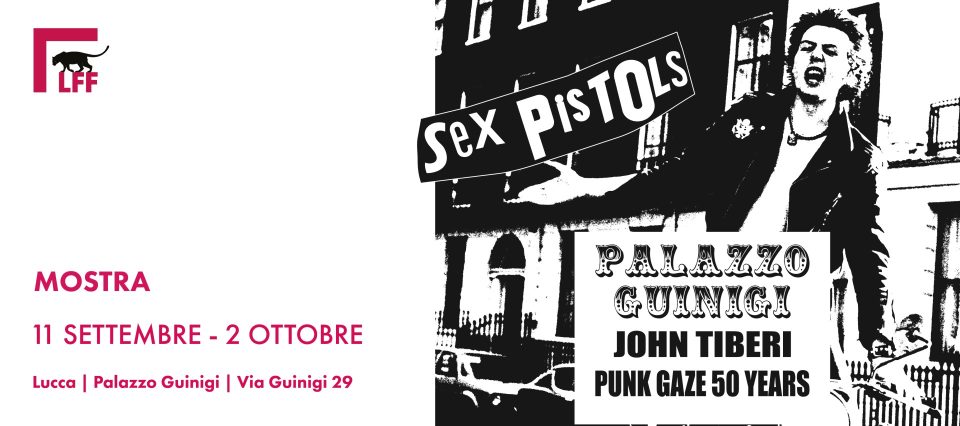
JOHN TIBERI: PUNK GAZE 50 YEARS
curated by Alessandro Romanini
A photography and video exhibition marking the 50th anniversary of the Sex Pistols’ “Anarchy in the U.K.” and tracing the birth and enduring legacy of punk through the eyes of John Tiberi.
Lucca | Palazzo Guinigi
11 September – 2 October 2026
Opening: Friday, 11 September at 6:00 pm
John Tiberi: Punk Gaze 50 Years, curated by Alessandro Romanini and presented by Lucca Film Festival 2026, will open on Friday, 11 September at 6:00 pm at Palazzo Guinigi, Via Guinigi 29 Lucca, where it will remain on view until 2 October 2026.
The exhibition marks 50 years since the release of “Anarchy in the U.K.”, the Sex Pistols’ debut single, released on 26 November 1976 and soon to become one of the defining statements of British punk. It emerged from a generation of young people determined to challenge the rules, languages and conventions of the society around them.
Music, art, cinema, publishing, design, fashion, literature, politics and communication were all transformed by the impact of this new energy. What remains of it today?
The exhibition explores this question through more than 25 photographs and videos by John Tiberi, revealing lesser-known aspects of that extraordinary cultural moment.
John Tiberi was not only the Sex Pistols’ tour manager and photographer — and previously manager of the 101’ers, before they evolved into The Clash — but also a first-hand witness to, and active participant in, a period of profound cultural change.
The story begins in the exceptionally hot London summer of 1976, remembered as the “Summer of Heat”, against the backdrop of what would become one of the final major countercultural revolutions of the 20th century.
Britain was going through a bleak period, marked by deep social and economic crisis, unemployment and widespread youth disaffection. London, meanwhile, was charged with tension and creative ferment: from the unrest surrounding the Notting Hill Carnival, rooted in the city’s large Caribbean community, to the Ramones’ landmark concert at Camden’s Roundhouse on 4 July.
Then came 26 November: a date that can be seen as a kind of Big Bang for British punk, with the release of “Anarchy in the U.K.” by the Sex Pistols, a band formed in 1975 by four young men barely out of their teens.
The song became the anthem of a generation unwilling to identify with established institutions or dominant cultural models. That disruptive energy would return the following year, in 1977, during Queen Elizabeth II’s Silver Jubilee, with “God Save the Queen”, the slogan “No Future”, and the now-iconic artwork by punk designer Jamie Reid, depicting the Queen with her eyes and mouth obscured.
Tiberi documented this historic moment from the inside through his work with the Sex Pistols.
The exhibition includes photographs of live performances, including the band’s concert in Gothenburg; images taken on the road; the group standing in front of the Berlin Wall; backstage moments; and scenes from SEX, the shop at 430 King’s Road that became a symbolic centre of the creative world shaped by Malcolm McLaren and Vivienne Westwood.
His photographs and videos capture not only the atmosphere of rebellion that defined the period, but also the philosophy of D.I.Y. — Do It Yourself. It was this attitude that encouraged young people to pick up a guitar, a camera, a typewriter or a photocopier to create fanzines, or needle and thread to construct their own style and identity.
Together with the legacy of Dada and Situationism, this remains one of punk’s most enduring ideas: the freedom to create without permission, to build one’s own tools and language, and to break into the mainstream through direct action.
Tiberi succeeded in conveying this spirit, as did filmmaker Julien Temple, who documented the Sex Pistols and the punk scene from their earliest days through numerous films and music videos. Lucca Film Festival will dedicate a special section of this year’s programme to Temple’s work. But punk’s legacy extends far beyond music. Its influence can be traced through cinema, literature, fashion and the visual arts. It appears in the work of writers such as Irvine Welsh, John Niven, Nick Hornby and Joseph O’Connor; in the collections of designers including Alexander McQueen and Jean Paul Gaultier; and in the work of Japanese designer Jun Takahashi, who played in the Tokyo Sex Pistols before founding the fashion label Undercover.
Contemporary art also absorbed and reworked punk’s visual language. In 1989, Damien Hirst created Sex Pistols Cabinet, an installation consisting of twelve medicine cabinets, each associated with the title of a song from the Sex Pistols’ first album. Artists from the Young British Artists generation — including Tracey Emin, Jake and Dinos Chapman, Sarah Lucas and Hirst himself — embraced provocation, irony and a rejection of convention: qualities that punk had already pushed into the cultural mainstream. In Persepolis, Iranian artist and activist Marjane Satrapi depicts her protagonist wearing a “Punk is not dead” T-shirt beneath her chador, an image that shows just how far punk had travelled beyond the geographical and cultural boundaries of 1970s London.
Its influence can also be recognised in the aesthetics of filmmakers such as Guy Ritchie and in the work of directors behind what could be called true punk films, among them Danny Boyle. Released in 1996, twenty years after the birth of British punk, Trainspotting brought to the screen the same sense of rupture, anger and alienation felt by a generation without clear reference points. Boyle would later return directly to the history of the Sex Pistols with Pistol, the 2022 miniseries tracing the formation and rise of the band through guitarist Steve Jones.
Punk Gaze 50 Years is therefore not simply an exhibition about the Sex Pistols or London in 1976.
It is a portrait of that moment and of the traces it has left across contemporary culture: an inheritance of images, music, attitudes and languages that still has the power to question the present.

–
–
Info Exhibition
JOHN TIBERI: PUNK GAZE 50 YEARS
curated by Alessandro Romanini
Lucca | Palazzo Guinigi | Via Guinigi 29
Opening hours: 10:00 am – 7:00 pm, daily
FREE ADMISSION
–
Contacts
Lucca Film Festival
segreteria@luccafilmfestival.it | www.luccafilmfestival.it
Lucca Film Festival Press Office: Reggi&Spizzichino Communication
Tel. +39 06 20880037 | Maya Reggi +39 347 6879999 | Raffaella Spizzichino +39 338 8800199 | Carlo Dutto +39 348 0646089
info@reggiespizzichino.com | www.reggiespizzichino.com
Lucca Film Festival Exhibitions Press Office: Davis & Co.
Lea Codognato ande Caterina Briganti | Tel. +39 055 2347273 | info@davisandco.it | www.davisandco.it
Communications and External Relations – Fondazione Cassa di Risparmio di Lucca
Andrea Salani | Tel. +39 0583 472627 | comunicazione@fondazionecarilucca.it